
You’ve probably heard of engine knock or pinging and know that it involves unwanted autoignition in a spark-ignition petrol engine. But what exactly does that mean, and what can cause it?
Combustion starts with the spark from the spark plug, and a flame front spreads through the mixture. This produces a smooth pressure rise in the combustion chamber. With knock, hot spots in the unburned mixture ahead of the flame front, known as the end gas, trigger additional autoignition events. These extra bursts of combustion happen far too abruptly, almost like small explosions. They cause an unwanted, sudden pressure rise, which you can often hear as knocking or pinging.

What causes knock?
Put simply: if the pressure and temperature in the end gas ahead of the flame front get too high, the risk of knock increases.
This can happen with:
- Too much spark advance: If the mixture is ignited earlier, it is compressed further while the piston is still moving upwards, increasing the pressure and temperature in the end gas.
- Too low an octane rating: The fuel has less knock resistance and autoignites more readily.
- A high compression ratio and boost: More pressure and higher temperatures in the end gas.
- High intake air temperatures (hot air or an ineffective intercooler): The mixture is already hotter to begin with.
- A mixture that is too lean: It burns hotter, and the mixture composition can also vary locally.
- Overheating or poor cooling: High cylinder wall and cylinder head temperatures heat up the end gas.
Surface ignition and pre-ignition are related to knock.
Here, a hot spot ignites the mixture before the spark plug fires. This has a similar effect to far too much spark advance and can then trigger knock as well.
This can happen with:
- Carbon build-up and deposits: They reduce the combustion chamber volume and therefore increase the compression ratio. They also act as insulation, become hot and can glow.
- An incorrect spark plug heat range: An overheated spark plug can act like a glow plug.
- Hot exhaust valves and sharp edges: They can create hot spots.
- Oil droplets and particles (especially in boosted direct-injection engines): They can trigger pre-ignition at low engine speeds, known as low-speed pre-ignition, or LSPI.

What do we see in practice?
In our experience, surface-induced pre-ignition is fairly rare. We usually only see the classic cases caused by carbon build-up and deposits in very high-mileage vehicles that have been poorly maintained. We do come across LSPI in boosted direct-injection engines from time to time, but it is not something we deal with every day either. Fresh oil approved by the vehicle manufacturer can help.
Keep an eye on the spark plugs, and don’t underestimate the difference they can make.
The biggest influences are fuel, spark timing, pressure and temperature. Most engines have a reasonable safety margin built in, although this varies between manufacturers.
The ECU will sort it out!
The good news is that the engine control unit (ECU) uses the knock sensors to detect knock and quickly retards the spark timing of the affected cylinder towards top dead centre (TDC) to stop it. Once knock is no longer detected, the ECU gradually brings the timing back towards the original value in the ignition map after a while, for example 7° before TDC (BTDC).

The catch: knock has to happen first, because the control system only reacts once it has occurred. That’s why we recommend calibrating the spark timing with a little margin below the knock limit. This leaves some room for variations in fuel quality or high temperatures.
A cylinder that knocks more heavily than the others can also produce a different amount of force. That can make the engine feel rougher and less smooth. The ECU will often intervene here too, reducing the effect.
Now for the tuning
Here’s the good news: thanks to those built-in margins, most engines don’t start knocking straight away, and there is usually room for more boost and more spark advance. The ECU’s knock retard is a useful indication of whether knock is occurring. When tuning, we can ultimately influence boost pressure, spark timing and, to a certain extent, temperature.
Then, of course, there is the fuel in the tank, which has a major influence on knock resistance. We recommend at least Super Plus petrol rated at 98 RON (approx. 93 AKI). The really good stuff with 100 to 102 RON (roughly 94–97 AKI, depending on the fuel), such as Aral Ultimate, is even better, or even E85 at around 104 to 105 RON (around 97 AKI for E85, depending on the blend). RON stands for Research Octane Number. AKI (Anti-Knock Index) is the average of RON and MON (Motor Octane Number). These AKI figures are approximate comparisons, not fixed conversions; the exact value depends on the fuel’s MON.
When tuning, you can increase boost and advance the spark timing to make more power. The important thing is to stay below the knock limit. An upgraded intercooler lowers the intake air temperature and therefore the mixture temperature as well. A very worthwhile investment. Injecting additional fuel also cools the mixture, but you must not overdo it.
Recognising surface ignition and pre-ignition
As described above, carbon build-up and deposits are among the possible causes. But how do you recognise it? Well, it isn’t always straightforward. If you have already retarded the spark timing considerably at a given boost pressure, to near TDC or even TDC, where knock should no longer be expected, yet knock is still being detected, that is a strong indication of carbon build-up or other hot spots. First, though, rule out other causes, such as poor fuel, excessively hot intake air, a mixture that is too lean or false knock detection.
Judging this takes some experience of the boost pressure, fuel and spark timing at which a particular engine would normally start to knock. Maintenance history and mileage matter too. If you suspect carbon build-up and deposits, our clear recommendation is to have the engine inspected and the deposits removed if necessary.
Knock and Run
There’s also the opposite case: the ECU hears knock even though the engine isn’t knocking at all. The knock sensor is mounted on the engine block and identifies knock from the vibrations it measures there. But it cannot tell where those vibrations come from. If mechanical vibrations are transmitted to the engine block, the ECU may interpret them as knock and pull timing, even though there is no actual knock.
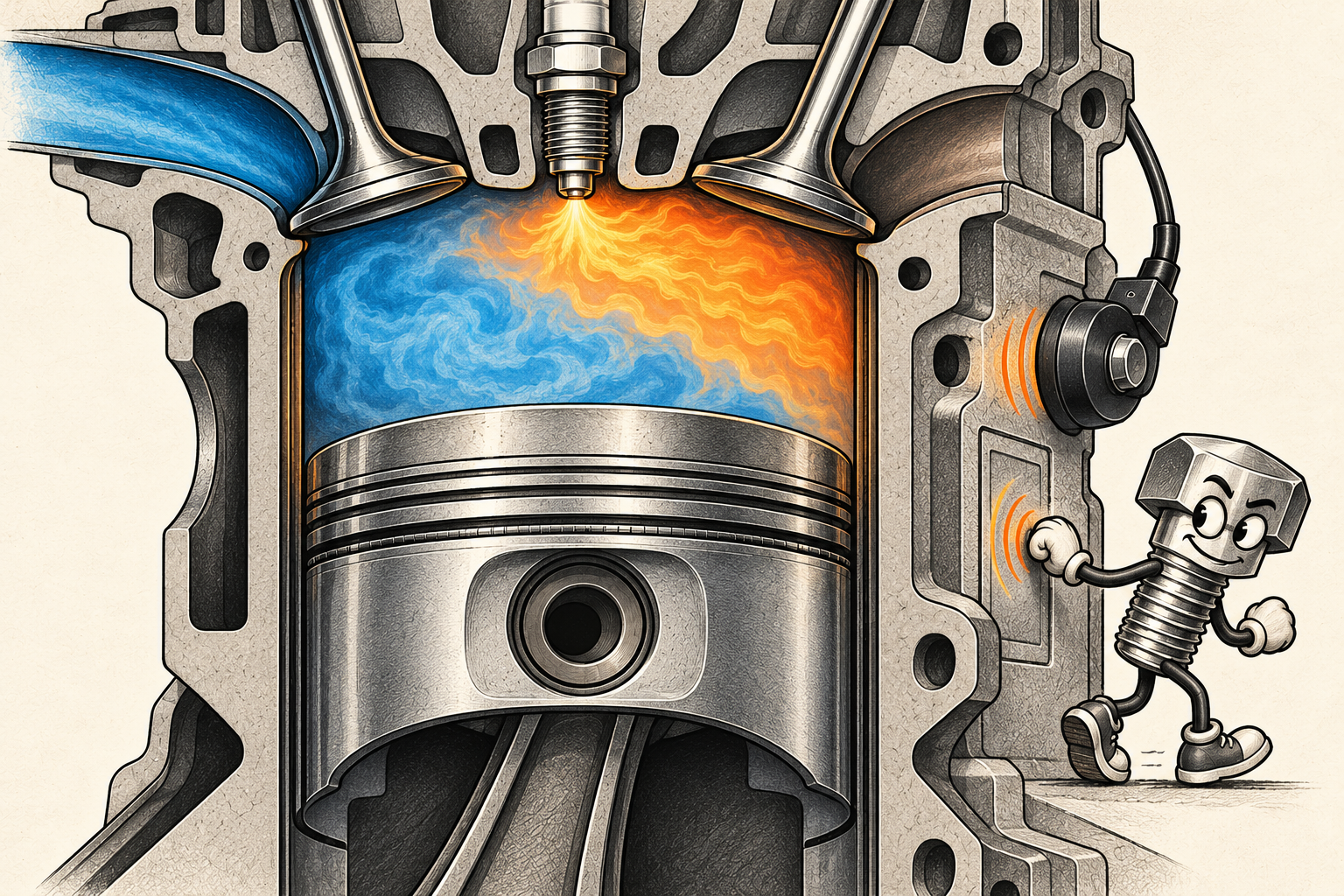
This is rare and tends to happen in modified engines when components unintentionally make contact with the engine block and transmit strong vibrations. Knock detection that is set too sensitively or a faulty knock sensor can also cause it.
An example from our workshop
A customer wanted a tune for 95 RON (approx. 90–91 AKI) petrol, which the manufacturer had also approved for his vehicle. Even during the initial baseline run on the stock software, we could see the ECU pulling a substantial 7° of timing. That tells you the engine is knocking.
Despite our recommendation to use 98 RON (approx. 93 AKI) Super Plus, the customer wanted a tune for 95 RON (approx. 90–91 AKI). The main aim was therefore to eliminate or at least minimise knock. We increased boost and reduced the original spark advance until the ECU no longer applied any knock retard. This allowed us to increase power and even make the engine run more smoothly. One important point: the further you retard the spark timing away from the optimum towards TDC, the more noticeably the engine loses power. Retarding the timing helps prevent knock, but comes at the expense of power output.
Let’s be clear, though: better fuel raises the knock limit and allows more spark advance. What surprised us was that the stock software was already knocking so early on the approved fuel that the ECU had to pull a significant amount of timing. That is not the norm, however.
The takeaway
- As a rule, knock is uncommon in a stock engine running the original software, usually occurring with poor fuel or very high ambient temperatures.
- Surface-induced pre-ignition is fairly rare and mainly occurs in high-mileage vehicles with heavy carbon build-up and deposits.
- The ECU detects knock and retards the spark timing to stop it.
- Fuel with a higher octane rating significantly reduces the risk of knock.
- When tuning, leave some margin below the knock limit to avoid unnecessary knock, even though the ECU retards the timing when it detects it.
Try it for yourself
You can explore how spark timing affects knock in our interactive animation.
Set the spark timing anywhere from 0° to 30° BTDC and watch how the flame front, hot spots in the end gas and pressure trace change. With late ignition, combustion is smooth, but you lose power. The earlier you fire the spark, the hotter the end gas gets, until it autoignites at one or more hot spots and the pressure starts to oscillate. One thing to bear in mind: the animation is a simplified model that illustrates the principle. It does not show measured data from a real engine.